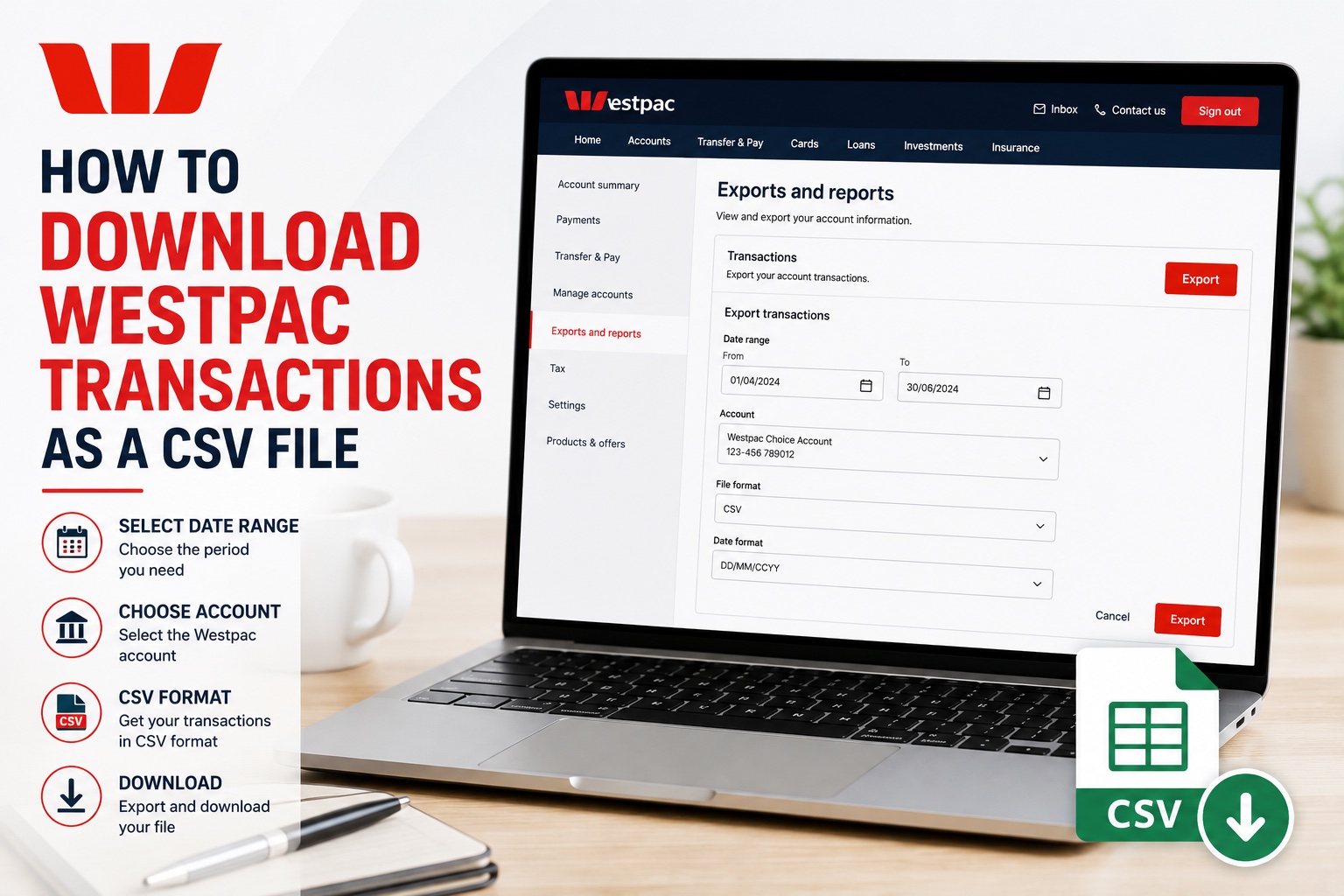
Need to download transactions from your Westpac bank account as a CSV file? Westpac Online Banking allows you to export transactions for a selected account and date range, giving you structured transaction data that can be used for bookkeeping, tax preparation, spreadsheets and financial reporting.
In this guide, we'll show you how to download Westpac bank transactions as a CSV file in just a few simple steps.
Watch the video tutorial below or follow the step-by-step instructions.
How to Download Westpac Transactions as CSV
Step 1: Log In to Westpac Online Banking
Start by logging in to your Westpac Online Banking account. Once you're logged in, navigate to the account containing the transactions you want to download.
Step 2: Open Exports and Reports
Find and click Exports and Reports. This section provides options for exporting financial information from your Westpac accounts.
Step 3: Select the Transaction Export
On the Exports and Reports page, find the Transactions section. Click Export to open the transaction export options.
Step 4: Choose Your Transaction Date Range
Enter the start and end dates for the transactions you want to download. For example, if you need transactions for the second quarter of the calendar year, you could select:
From: 1 April
To: 30 June
You can choose a date range that matches your bookkeeping, tax or reporting requirements. This makes it possible to export transactions for a particular month, quarter or other custom period.
Step 5: Select Your Westpac Bank Account
Choose the Westpac bank account containing the transactions you want to export. If you have several accounts, make sure you select the correct one before downloading the file.
Step 6: Select CSV as the File Format
Under File Format, select CSV. CSV stands for Comma-Separated Values. It's a widely supported format used to transfer structured data between banks, spreadsheets, bookkeeping applications and accounting software.
Step 7: Choose Your Date Format
Westpac also allows you to choose how dates are formatted within your exported transaction file. For the standard Australian date format, select:
DD/MM/CCYY
For example, 30 June 2026 would appear as:
30/06/2026
Choosing the appropriate date format can be useful if you're planning to open the CSV in spreadsheet software or import the file into another financial application.
Step 8: Export Your Westpac Transactions
Once you've selected your account, date range, CSV file format and preferred date format, click Export. Your Westpac transactions will then be downloaded as a CSV file. That's it! You now have a CSV file containing your Westpac bank transactions for the selected period.
Why Download Westpac Transactions as a CSV File?
A CSV transaction export is useful when you need to work with your banking data, rather than simply read it.
Unlike a PDF bank statement, CSV files store individual transactions as structured data that can be sorted, filtered, categorized and processed.
You may want to download your Westpac transactions as CSV for:
Bookkeeping
Tax preparation
BAS preparation
Business expense tracking
Income tracking
Transaction categorisation
Spreadsheet analysis
Creating Profit & Loss statements
Importing transactions into compatible accounting software
Sharing transaction data with your accountant
This can be particularly useful for sole traders, freelancers, contractors, gig workers and small businesses that regularly need to organize large numbers of banking transactions.
Westpac CSV vs PDF Bank Statement: Which Do You Need?
Whether you should download your Westpac banking information as CSV or PDF depends on what you're trying to accomplish.
PDF Bank Statements
A PDF bank statement is generally more appropriate when you need a readable financial document showing your account activity for an official statement period.
PDF statements may be useful for:
Proof of income
Loan applications
Mortgage applications
Rental applications
Financial record keeping
Providing statements to your accountant
CSV Transaction Files
CSV is usually the better option when you need to process or analyze individual transactions.
CSV files make it easier to:
Sort transactions
Filter transactions
Search transaction descriptions
Categorize expenses
Identify income
Calculate totals
Import data into compatible financial applications
Prepare financial reports
If your ultimate goal is to prepare a Profit & Loss statement, downloading your Westpac transactions as CSV can be much more convenient than manually copying transaction information from PDF statements.
Using Westpac CSV Transactions for Bookkeeping
If you use a Westpac account for business activity, the CSV export can provide much of the raw financial data needed for bookkeeping.
Your transactions might include business income such as:
Customer payments
Client payments
Uber or rideshare payouts
Delivery platform payments
Marketplace income
Other business revenue
Your business expenses might include:
Fuel
Vehicle expenses
Tolls and parking
Phone and internet
Software subscriptions
Advertising
Insurance
Equipment
Professional services
Bank fees
Other operating expenses
The challenge is turning those raw transactions into organized financial records.
Turn Your Westpac Transactions Into a Profit & Loss Statement
Downloading your Westpac transactions is only the first step if your goal is to understand how your business is performing.
To manually create a Profit & Loss statement, you would typically need to:
Download your bank transactions.
Review each transaction.
Separate personal and business transactions.
Identify business income.
Identify business expenses.
Assign each expense to the correct category.
Calculate totals for each category.
Calculate total income and expenses.
Determine your net profit.
Build the final Profit & Loss statement.
For an account containing hundreds or thousands of transactions, this can become time-consuming.
Accounting Samurai can help simplify the process.
Instead of manually working through every transaction in a spreadsheet, you can use your bank transaction data to generate an organized Profit & Loss statement more efficiently.
This can be particularly useful for:
Uber drivers
Rideshare drivers
Uber Eats drivers
DoorDash drivers
Amazon Flex drivers
Gig workers
Freelancers
Contractors
Sole traders
Small business owners
Generate a P&L From Your Westpac Transactions
Already downloaded your Westpac transactions?
Upload your banking data to Accounting Samurai and turn your income and expenses into an organized Profit & Loss statement without manually building one from scratch.
👉 Generate Your Free Profit & Loss Statement Now
Frequently Asked Questions
Can I download Westpac bank transactions as a CSV file?
Yes. Westpac Online Banking provides an export feature that allows you to download transactions from a selected bank account in CSV format.
Where can I export transactions in Westpac Online Banking?
Log in to Westpac Online Banking and navigate to Exports and Reports. Find the Transactions section and select Export to access the transaction export options.
Can I choose a custom date range for Westpac transactions?
Yes. You can enter the start and end dates for the transactions you want to export, making it possible to create files for monthly, quarterly or other custom reporting periods.
What file format should I choose for Westpac transactions?
If you want to use your transactions in a spreadsheet, bookkeeping application or other compatible financial tool, select CSV as the file format.
What date format should I use for a Westpac CSV export?
For the standard Australian date format, select DD/MM/CCYY. Choose the format that works best with the spreadsheet or financial application where you plan to use the file.
What can I do with a Westpac CSV transaction file?
A CSV transaction export can be used for bookkeeping, tax preparation, BAS preparation, expense tracking, income categorization, spreadsheet analysis and preparing financial reports such as Profit & Loss statements.
Should I download Westpac transactions as CSV or PDF?
Use PDF when you primarily need a readable bank statement or supporting financial document.
Use CSV when you need to sort, analyze, categorize, import or otherwise process individual transactions.
Can I create a Profit & Loss statement from Westpac transactions?
Yes. You can manually categorize the business income and expenses contained in your CSV export and use those figures to prepare a Profit & Loss statement.
Alternatively, a tool such as Accounting Samurai can help reduce the amount of manual transaction processing required.